Trends and Developments: Autonomous Driving and the Chambers Global Practice Guide


Modern connected vehicles are complex systems in which control units, sensors, advanced driver assistance systems (ADAS), over-the-air updates (OTA) and backend platforms interact. From a legal perspective, this means that the focus is shifting from purely mechanical defects to software-related risks, data quality, algorithmic decisions and cybersecurity threats.
As artificial intelligence (AI), software and software-controlled products continue to develop, both the product-safety and liability frameworks are expanding beyond traditional hardware defects to encompass software, connectivity, automated functions and autonomous driving.
Software, vehicle data, updates and IT security are now central elements of product safety and product compliance. They will significantly influence how courts interpret the concepts of a product, a product defect and the “safety that a person is entitled to expect” under the new EU Product Liability Directive and the Austrian Product Liability Act.
Defective algorithms, inadequately tested software versions, insufficient security updates or vulnerabilities in vehicle IT may give rise to liability just as a conventional brake or airbag defect would. This is particularly relevant to automated driving, highly automated driving functions and autonomous vehicle systems, where driving behaviour is largely controlled by software.
At the same time, the scope of strict, no-fault product liability is expanding to include new participants in the automotive value chain. Alongside vehicle manufacturers (OEMs) and traditional suppliers, software developers, platform operators, cloud providers and suppliers of AI modules for perception, object detection, lane keeping, emergency braking assistance or driving decisions are increasingly performing safety-critical functions. As a result, they are becoming more exposed to product liability claims, recalls and regulatory product-safety proceedings. The same applies to providers of connected mobility services, fleet operators and operators of charging and infrastructure systems in the field of e-mobility.
For companies in the automotive and mobility sectors, this development means that product-liability risks, product-safety requirements and product-compliance issues can no longer be considered in isolation. Agreements throughout the supply chain – including development, software-licensing, supply and platform agreements between OEMs, Tier 1 suppliers, software companies and data-service providers – must precisely allocate liability, indemnities, insurance arrangements, update obligations, product-monitoring duties and cybersecurity responsibilities. Internal compliance structures and governance systems must systematically reflect the requirements of product-liability law, product-safety law, vehicle type approval, cybersecurity regulation and IT security standards such as ISO 26262, ISO/SAE 21434 and ISO 21448.
The concepts of “Safety by Design” and “Security by Design” are also becoming increasingly important for automated and connected vehicles. Product development, system architecture, software engineering, testing and validation must be closely integrated with legal risk analysis from the outset. This includes documented hazard and risk assessments, testing and approval concepts, traceability of software versions and processes for product monitoring, incident response, recalls and over-the-air updates. Only by bringing together technical, legal and organisational perspectives can businesses effectively manage liability risks, meet regulatory requirements and build the trust of consumers, authorities and business partners that is essential to the market success of automated and connected mobility.
More information is available here:
Product Liability & Safety 2026 – Austria | Global Practice Guides | Chambers and Partners
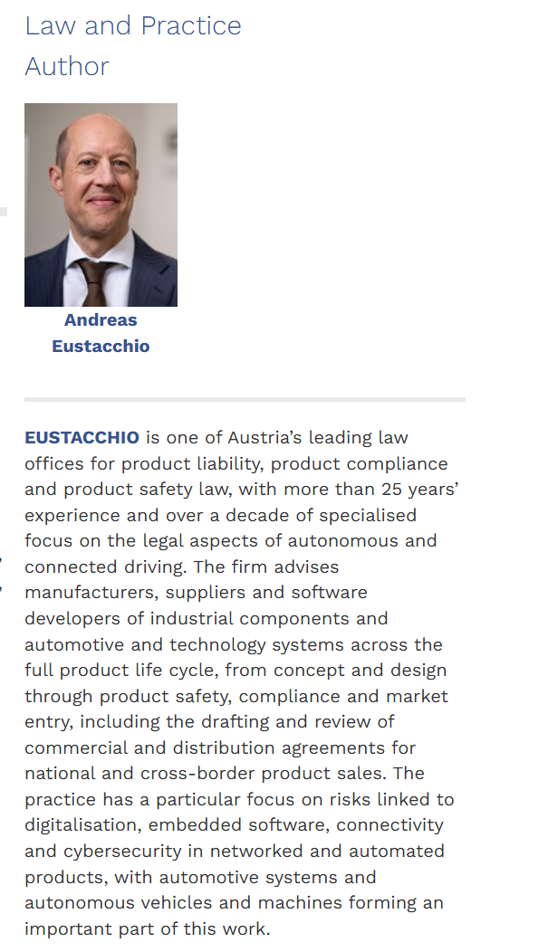
Andreas EUSTACCHIO has specialist legal expertise and many years of experience in autonomous and connected driving. He advises manufacturers, suppliers and software developers throughout the entire product lifecycle, including market entry and commercial agreements. His particular focus is on the risks associated with digitalisation, embedded software, connectivity, cybersecurity and automated systems.